
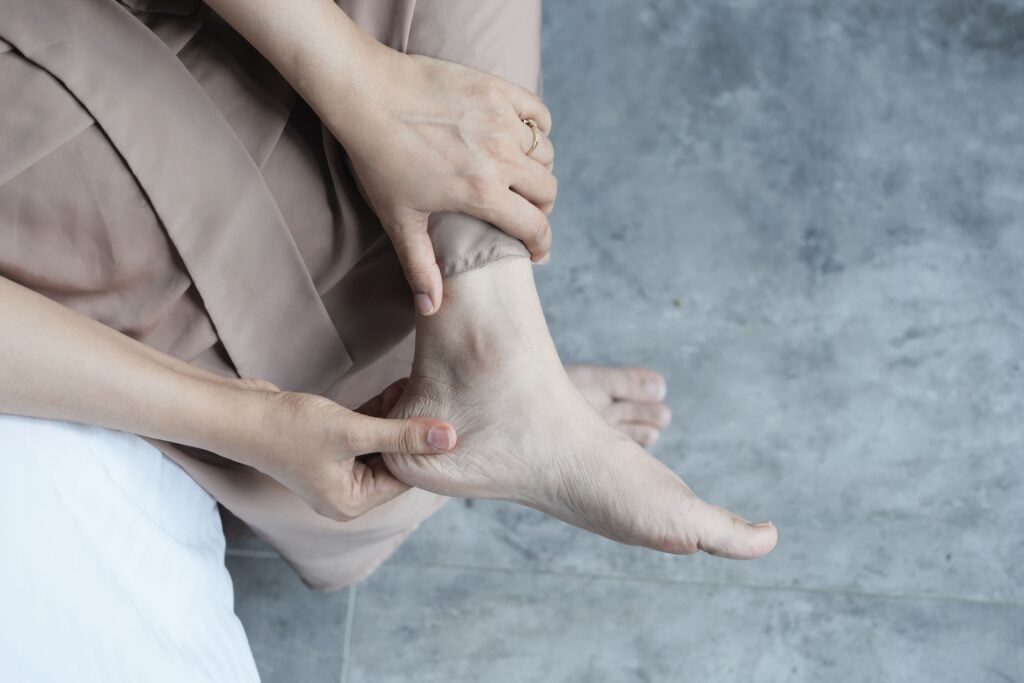
VA rates plantar fasciitis under its own diagnostic code, 5269, at 10, 20, or 30 percent. A 40 percent rating applies if you lose the use of the foot. Which level applies depends on whether one or both feet are affected and whether non-surgical and surgical treatment have both failed to bring relief. Plantar fasciitis is different from flat feet and heel spurs, and VA rates it separately from both.
Key takeaways
- Plantar fasciitis is common in the military, and VA has rated it under its own code, DC 5269, since February 7, 2021.
- Higher ratings depend on treatment history, so your records need to show which treatments you tried and whether they helped.
- Start by getting a current diagnosis documented, then confirm how the condition connects to your service or to an already service-connected condition.
What is plantar fasciitis?
Plantar fasciitis is irritation of the plantar fascia, the thick band of tissue that runs along the bottom of your foot from your heel to your toes. Cleveland Clinic describes it as the most common cause of heel pain, often worst with the first steps in the morning or after sitting.
It is especially common among service members. A study of U.S. military medical records from 1998 to 2006 found about 10.5 new cases per 1,000 service members each year. Women had roughly twice the rate of men, and soldiers in the Army had a higher rate than Air Force members.
How does VA rate plantar fasciitis?
VA rates plantar fasciitis at 10, 20, 30, or 40 percent under diagnostic code (DC) 5269 in 38 CFR 4.71a, the musculoskeletal part of VA’s rating schedule. The code was added in a 2021 Federal Register correction, effective February 7, 2021.
The rating levels are:
- 30 percent: no relief from both non-surgical and surgical treatment, in both feet (bilateral).
- 20 percent: no relief from both non-surgical and surgical treatment, in one foot (unilateral).
- 10 percent: all other cases, in one foot or both.
- 40 percent: actual loss of use of the foot, under Note (1) of the code.
Note (2) adds an important exception. If a provider recommended surgery but you are not a surgical candidate, VA evaluates you under the 20 or 30 percent criteria, whichever applies.
In practice, the key phrase is “no relief from both non-surgical and surgical treatment.”
Non-surgical treatment can include stretching, supportive shoes, orthotics, physical therapy, and injections. Unless both kinds of treatment have failed, or Note (2) applies, the criteria point to 10 percent. Treatment decisions should be made with your provider for medical reasons, never to reach a rating level.
How do you get plantar fasciitis service-connected?
You can get plantar fasciitis service-connected directly, if it started or was diagnosed during service, or on a secondary basis, if a service-connected condition caused or worsened it. Either way, VA expects a current diagnosis and evidence linking it to service.
- Direct service connection: Under 38 CFR 3.303, a condition diagnosed after discharge can still be service-connected when the evidence shows it began in service. In-service treatment notes for heel pain are strong evidence.
- Secondary service connection: Under 38 CFR 3.310, plantar fasciitis can be secondary when a service-connected knee, hip, ankle, or back condition changed how you walk and a clinician links the two. Our guide to how VA secondary conditions work explains this path.
For either path, medical opinions are usually written to the “at least as likely as not” standard, meaning a 50 percent or greater probability. When the evidence is roughly balanced, VA resolves the doubt in the veteran’s favor under 38 CFR 3.102.
Can VA rate plantar fasciitis and flat feet together?
Sometimes. VA can rate both conditions when each causes different symptoms, but it won’t pay twice for the same symptom.
That rule is called pyramiding. Under 38 CFR 4.14, VA avoids rating the same disability under different diagnoses. Flat feet (pes planus) and plantar fasciitis can both cause foot pain, so a clear medical record showing which symptoms come from which condition matters. A detailed foot exam, sometimes on a Disability Benefits Questionnaire, can help; see our article on how VA DBQs work.
How the process works
You file a plantar fasciitis claim like any other disability claim, but the treatment history carries extra weight. Timelines may vary by claim and VA workload.
- Get a current diagnosis. A provider should document which foot or feet are affected, your symptoms, and how they limit standing and walking.
- Collect your treatment history. Records of orthotics, physical therapy, injections, medication, and any surgery or surgical consultation all bear on the rating level.
- Gather service evidence. In-service sick-call or profile records for heel pain support direct service connection. For a secondary claim, you need records of the primary service-connected condition.
- Consider a medical opinion. A nexus opinion is a clinician’s written analysis of whether the condition is at least as likely as not related to service. Learn more in what a nexus letter is.
- File the claim. You can file on the standard disability application (VA Form 21-526EZ) through VA.gov, by mail, or with help from an accredited representative.
- Attend any exam VA schedules. VA often orders a compensation and pension (C&P) exam, which VA uses to help decide whether you have a service-connected disability. Our guide to what to expect at a C&P exam can help you prepare.
If you need a physician’s review of how your plantar fasciitis connects to service or to another condition, HealthSource’s veteran nexus services can provide an independent medical opinion.
What a nexus opinion can and cannot do
A nexus opinion helps, but it has limits.
- It reflects the physician’s honest conclusion. After reviewing your records, a physician may find that the evidence does not support a connection, and the opinion will say so.
- It does not decide the claim or the rating. VA raters weigh all the evidence, including C&P exam results, and assign the rating.
- It doesn’t file or argue your claim. HealthSource provides medical opinions only. Help preparing, filing, or appealing a claim comes from VA-accredited attorneys, claims agents, or Veterans Service Organization representatives, which you can find through VA’s accreditation search.
Common mistakes and delays
Most problems come down to gaps in the medical record.
- Claiming “foot pain” without a specific diagnosis of plantar fasciitis in one or both feet.
- Leaving out treatment records, which makes it hard to show whether non-surgical and surgical treatment helped.
- Not noting whether surgery was recommended, which matters under Note (2) of DC 5269.
- Describing the same symptoms for flat feet and plantar fasciitis without separating them.
- Missing a scheduled C&P exam, which VA says will delay your claim.
- Treating a denial as final. VA’s decision review options include a Supplemental Claim with new and relevant evidence, a Higher-Level Review, or a Board Appeal.
When to seek medical attention
Plantar fasciitis usually improves with home care, but some signs may need a provider’s attention. Cleveland Clinic recommends seeing a provider if heel or foot pain doesn’t improve on its own within a week, or if symptoms don’t improve after two weeks of treatment.
Get prompt care if you notice:
- Severe heel pain after an injury, or pain that makes it hard to put weight on your foot.
- Numbness, tingling, or burning in your foot.
- Redness, warmth, or swelling with fever.
This is not an emergency service. In an emergency, call 911 or go to the nearest emergency room.
Frequently asked questions
Is plantar fasciitis a VA disability?
Yes. VA rates plantar fasciitis under its own diagnostic code, DC 5269, when it is service-connected. You still need a current diagnosis and evidence linking it to service or to a service-connected condition.
What is the highest VA rating for plantar fasciitis?
The schedule tops out at 30 percent for both feet when neither non-surgical nor surgical treatment has helped. Note (1) allows 40 percent when there is actual loss of use of the foot.
Do I need surgery to get more than 10 percent?
The 20 and 30 percent levels require no relief from both non-surgical and surgical treatment. Under Note (2), VA also applies those levels if surgery was recommended but you are not a surgical candidate. Surgery is something you decide with your provider, not a step toward a rating.
Can plantar fasciitis be secondary to a knee or back condition?
It can, if a clinician finds that a service-connected knee, hip, ankle, or back condition changed how you walk and caused or worsened your plantar fasciitis. VA looks for medical evidence explaining that link.
Do orthotics count as treatment?
Orthotics and supportive shoes are common non-surgical treatments, and records of using them help show your treatment history. They are one part of the “no relief from both non-surgical and surgical treatment” question, not a rating level on their own.
Get an independent medical opinion for your claim
If you have a plantar fasciitis diagnosis and need a review of its connection to service, a board-certified physician at HealthSource Medical Associates can provide an independent medical opinion through veteran nexus services. Visits take place by secure video, and current pricing and availability are on the booking page. You must be physically located in a state where the provider is licensed at the time of your visit.
Sources
- Electronic Code of Federal Regulations. Accessed November 6, 2026. 38 CFR 4.71a: Schedule of ratings, musculoskeletal system. https://www.ecfr.gov/current/title-38/chapter-I/part-4/subpart-B/subject-group-ECFRd3005f7d828ea7b/section-4.71a
- Federal Register (via Justia). February 4, 2021. Schedule for Rating Disabilities: Musculoskeletal System and Muscle Injuries; Correction, 86 FR 8142. https://regulations.justia.com/regulations/fedreg/2021/02/04/2021-01289.html
- Electronic Code of Federal Regulations. Accessed November 6, 2026. 38 CFR 3.303: Principles relating to service connection. https://www.ecfr.gov/current/title-38/chapter-I/part-3/subpart-A/subject-group-ECFR39056aee4e9ff13/section-3.303
- Electronic Code of Federal Regulations. Accessed November 6, 2026. 38 CFR 3.310: Disabilities that are proximately due to, or aggravated by, service-connected disease or injury. https://www.ecfr.gov/current/title-38/chapter-I/part-3/subpart-A/subject-group-ECFR39056aee4e9ff13/section-3.310
- Electronic Code of Federal Regulations. Accessed November 6, 2026. 38 CFR 3.102: Reasonable doubt. https://www.ecfr.gov/current/title-38/chapter-I/part-3/subpart-A/subject-group-ECFR63da83ba671b92b/section-3.102
- Electronic Code of Federal Regulations. Accessed November 6, 2026. 38 CFR 4.14: Avoidance of pyramiding. https://www.ecfr.gov/current/title-38/chapter-I/part-4/subpart-A/section-4.14
- Scher DL, Belmont PJ Jr, Bear R, Mountcastle SB, Orr JD, Owens BD. The incidence of plantar fasciitis in the United States military. J Bone Joint Surg Am. 2009;91(12):2867-2872. doi:10.2106/JBJS.I.00257. https://doi.org/10.2106/JBJS.I.00257
- Cleveland Clinic. Accessed November 6, 2026. Plantar fasciitis. https://my.clevelandclinic.org/health/diseases/14709-plantar-fasciitis
- U.S. Department of Veterans Affairs. Accessed November 6, 2026. How to file a VA disability claim. https://www.va.gov/disability/how-to-file-claim/
- U.S. Department of Veterans Affairs. Accessed November 6, 2026. VA claim exam (C&P exam). https://www.va.gov/resources/va-claim-exam/
- U.S. Department of Veterans Affairs. Accessed November 6, 2026. Choosing a decision review option. https://www.va.gov/resources/choosing-a-decision-review-option/
- U.S. Department of Veterans Affairs, Office of General Counsel. Accessed November 6, 2026. Accreditation search. https://www.va.gov/ogc/apps/accreditation/
Medical documentation supports your request but does not guarantee approval. Final decisions are made by your employer, insurance carrier, leave administrator, school, applicable state program, or the Department of Veterans Affairs.
This article is for informational purposes only and is not a substitute for professional medical advice.
This is not an emergency service. In an emergency, call 911 or go to the nearest emergency room.